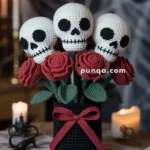
Add a touch of spooky elegance to your handmade creations with the Amigurumi Skull Bouquet, a delightfully macabre crochet project that’s perfect for Halloween, gothic weddings, or anyone who loves a twist on tradition! 💀🌸 Featuring a cluster of charming little skulls nestled among yarn blooms, this bouquet blends eerie vibes with soft, sculptural beauty. Whether displayed in a vase, gifted to a fellow spooky soul, or used as a haunting centerpiece, it’s sure to turn heads and spark conversations.
This pattern is ideal for crocheters who love mixing whimsy with edge. You can customize each skull with different expressions, play with flower colors for seasonal flair, or even add lace and ribbons for a romantic gothic twist. Whether you’re crafting for a celebration or simply embracing your love of the unconventional, the Amigurumi Skull Bouquet is a bone-chillingly beautiful way to stitch up charm—one haunting loop at a time! 🧶🕯️

Amigurumi Spooky-Cute Skull Bouquet Crochet Pattern
Create this whimsical skull and foliage arrangement that’s perfect for Halloween, Day of the Dead, or adding a touch of playful darkness to your home!
There’s something irresistibly charming about skulls paired with golden botanicals. This crochet bouquet strikes the perfect balance between spooky and sophisticated, making it ideal for gothic home décor, Halloween celebrations, or as a unique gift for those who appreciate the beautifully macabre.
With smiling skull blooms nestled among plump golden leaves and delicate accent spheres, this bouquet brings personality and handmade warmth to any space. Whether displayed on a mantel, bookshelf, or as a centerpiece, it’s a conversation starter that never wilts!
What You’ll Create
This project results in a stunning 10-12 inch (25-30 cm) tall bouquet featuring four cheerful skulls with embroidered faces, surrounded by dimensional oval leaves, golden accent balls, and delicate branching sprigs—all arranged in a coordinating cylindrical vase.
Before You Begin
Skill Level
Intermediate – This pattern requires experience with shaping spheres, embroidery details, wire manipulation, and multi-component assembly. It’s perfect if you’ve completed several amigurumi projects and are ready for something with more parts!
Time Commitment
Plan for 10-15 hours total, depending on your speed. Each skull takes about 45 minutes, and the foliage elements add up quickly, but they’re enjoyable to make while watching your favorite spooky shows!
Materials You’ll Need
Yarn
Worsted weight yarn in:
- White – skull heads (approximately 100g)
- Black – facial features and embroidery (small amount, 20g)
- Mustard/Golden yellow – all foliage, vase, accent balls (approximately 150g)
- Optional: Slightly darker gold/burnt orange for color variation in leaves
I recommend using a soft, smooth yarn with good stitch definition for the skulls, and a slightly textured yarn for the botanical elements adds nice dimension.
Tools & Supplies
- 3.0–3.5 mm crochet hook
- Polyester fiberfill stuffing
- Floral wire or pipe cleaners (20-gauge works well)
- Yarn needle
- Stitch markers
- Scissors
- Black embroidery floss (for cleaner facial details)
- Hot glue gun (optional, for securing stems)
- Floral foam or extra stuffing (for anchoring stems in vase)
Abbreviations Guide (US Terms)
- MR = Magic Ring
- sc = single crochet
- inc = increase (2 sc in same stitch)
- dec = decrease (invisible sc2tog)
- hdc = half double crochet
- dc = double crochet
- sl st = slip stitch
- st = stitch
- ch = chain
- FO = fasten off
Creating the Skull Flowers
These adorable skull heads are the stars of your bouquet! Each one gets its own personality through embroidery.
Skull Head Construction (Make 4 in white)
R1: MR, 6 sc [6]
R2: inc × 6 [12]
R3: (1 sc, inc) × 6 [18]
R4: (2 sc, inc) × 6 [24]
R5: (3 sc, inc) × 6 [30]
R6-R10: sc around [30] (5 rounds straight)
R11: (3 sc, dec) × 6 [24]
R12: (2 sc, dec) × 6 [18]
R13: (1 sc, dec) × 6 [12]
Stuff very firmly – skulls need to hold their shape on stems!
R14: dec × 6 [6]
FO, leaving a long tail. Thread tail through remaining 6 stitches and pull tight to close. Weave in securely.
Shaping tip: As you stuff, shape the skull to be slightly wider at the “forehead” (rounds 6-8 area) and more rounded at the back for a realistic skull shape.
Bringing Skulls to Life: Facial Features
This is where personality emerges! Take your time with the embroidery—it makes all the difference.
Eyes (Make 2 per skull in black)
Instead of flat circles, we’re creating slightly dimensional eyes:
R1: MR, 6 sc [6]
R2: inc × 6 [12]
R3: sc around [12]
FO, leaving a long tail.
Stuff each eye very lightly with just a tiny bit of fiberfill to create a subtle dome. Flatten slightly and sew to the skull face.
Placement: Position eyes between rounds 6-7 of the skull, approximately 6-8 stitches apart. The eyes should be in the upper half of the skull face, creating that classic skull look.
Nose (Black embroidery)
Using black embroidery floss (all 6 strands for thickness):
Create a small upside-down heart shape or two small circular nostrils centered between and slightly below the eyes.
Method:
- Mark the position with a pin
- Create the outline first with small stitches
- Fill in solidly with satin stitch
- Keep it small – about 3-4 stitches wide
Mouth (Black embroidery)
This is what gives your skulls their friendly personality!
Creating the smile:
- Using black embroidery floss, create a wide curved line that extends from one side of the skull to the other, positioned below the nose
- The curve should smile upward slightly at the edges
- Use backstitch for a clean, smooth line
Adding teeth: From the smile line, embroider 6-7 evenly spaced vertical lines downward to create individual teeth. Each tooth line should be about 3-4 mm long.
Pro tip: Make the center teeth slightly longer than the side teeth for a more natural skull appearance!
Golden Accent Balls
These cheerful spheres add pops of dimension throughout the bouquet.
Accent Ball Construction (Make 3-4 in mustard/gold)
R1: MR, 6 sc [6]
R2: inc × 6 [12]
R3: (1 sc, inc) × 6 [18]
R4-R5: sc around [18] (2 rounds)
R6: (1 sc, dec) × 6 [12]
Stuff firmly but not tightly—you want round spheres, not overstuffed balls.
R7: dec × 6 [6]
FO, leaving a long tail. Close opening and weave in.
Oval Paddle Leaves: The Secret to Fullness
These plump, rounded leaves are key to recreating the lush, dimensional look of the bouquet. You’ll make them in varying sizes for visual interest.
Small Oval Leaf (Make 4-5 in mustard/gold)
R1: MR, 6 sc [6]
R2: inc × 6 [12]
R3: (1 sc, inc) × 6 [18]
R4-R5: sc around [18] (2 rounds)
R6: (1 sc, dec) × 6 [12]
R7: dec × 6 [6]
FO, leaving a long tail (at least 8 inches for attaching).
Shaping: Stuff each leaf very lightly—just enough to give it body—then flatten into an oval paddle shape. The leaf should be plump but not round.
Medium Oval Leaf (Make 4-5 in mustard/gold)
R1: MR, 6 sc [6]
R2: inc × 6 [12]
R3: (1 sc, inc) × 6 [18]
R4: (2 sc, inc) × 6 [24]
R5-R6: sc around [24] (2 rounds)
R7: (2 sc, dec) × 6 [18]
R8: (1 sc, dec) × 6 [12]
R9: dec × 6 [6]
FO, leaving a long tail.
Stuff lightly and flatten into oval paddle shape.
Large Oval Leaf (Make 2-3 in mustard/gold)
R1: MR, 6 sc [6]
R2: inc × 6 [12]
R3: (1 sc, inc) × 6 [18]
R4: (2 sc, inc) × 6 [24]
R5: (3 sc, inc) × 6 [30]
R6-R7: sc around [30] (2 rounds)
R8: (3 sc, dec) × 6 [24]
R9: (2 sc, dec) × 6 [18]
R10: (1 sc, dec) × 6 [12]
R11: dec × 6 [6]
FO, leaving a long tail.
Stuff lightly and flatten into large oval paddle shape.
Optional color variation: Make some leaves in a slightly darker burnt orange or deeper golden shade for natural variation.
Branching Leaf Sprigs
These create height and delicate texture throughout the arrangement.
Branching Sprig Construction (Make 3-4 in mustard/gold)
Main stem:
Ch 18-22 (varies for different heights)
Row 1: sc in 2nd ch from hook, sc across [17-21]
FO, but don’t weave in—you’ll use this tail.
Small side leaves (make 6-8 per sprig):
R1: MR, 6 sc [6]
R2: inc × 6 [12]
R3: sc around [12]
FO, leaving a 6-inch tail.
Stuff very lightly and flatten slightly.
Assembling the Branching Sprig
- Take your main stem (the chain strip)
- Position 3-4 small leaves along one side, spacing them evenly
- Sew each leaf to the stem at an angle, alternating the direction slightly
- Work back and attach 3-4 more leaves on the opposite side
- Stagger the leaves so they don’t line up directly across from each other
Result: You’ll have a delicate branching sprig with multiple small oval leaves extending from a central stem—perfect for adding height and movement to your bouquet!
The Vase: Foundation of Your Bouquet
This sturdy cylinder holds everything together beautifully.
Vase Construction (Mustard/gold)
R1: MR, 6 sc [6]
R2: inc × 6 [12]
R3: (1 sc, inc) × 6 [18]
R4: (2 sc, inc) × 6 [24]
R5: (3 sc, inc) × 6 [30]
R6: (4 sc, inc) × 6 [36]
R7-R18: sc around [36] (12 rounds—creates nice height)
Optional rim detail:
R19: Working in FLO, (2 sc, inc) × 12 [48] – this creates a subtle flare at the top
FO, weave in ends.
Structural tip: Insert a cardboard circle cut to fit the base for stability. Stuff the bottom third of the vase with fiberfill so it stands upright and has weight.
Preparing Stems: The Backbone of Your Arrangement
Proper stem preparation makes assembly much easier!
Creating Wire Stems
For each skull, accent ball, and larger leaf cluster, you’ll need a wire stem.
For skulls (make 4):
- Cut floral wire 8-10 inches long
- Insert wire through the bottom center of the skull, pushing up about 1 inch into the stuffing
- Using matching white yarn, wrap the bottom portion of wire tightly with yarn to secure and hide the wire
- Continue wrapping with mustard/gold yarn for the remaining stem length
For accent balls (make 3-4):
- Cut floral wire 6-8 inches long
- Insert through center of ball
- Wrap entirely with mustard/gold yarn
For large branching sprigs (make 3-4):
- Attach the sprig directly to an 8-10 inch piece of floral wire using the long tail
- Wrap wire with mustard/gold yarn
For leaf clusters:
- Group 2-3 oval leaves together
- Attach to a 6-8 inch wire using the long tails
- Wrap wire with mustard/gold yarn
Pro tip: Add a tiny drop of hot glue where the yarn wrapping starts to prevent slipping!
Assembly: Bringing Your Bouquet to Life
This is where all your hard work comes together! Take your time with placement—you can always adjust before permanently securing anything.
Step 1: Prepare the Vase Base
Fill the bottom third of your vase with stuffing for weight and stability. Create a small piece of floral foam (or use tightly packed stuffing) that fits snugly in the top portion of the vase—this will hold your stems in place.
Step 2: Position the Skulls
Placement strategy:
- Position skulls at slightly different heights for visual interest
- Angle them in different directions so they’re looking slightly away from each other
- Space them evenly throughout the arrangement, not clustered together
Method:
- Starting with your tallest skull, insert the wire stem into the foam base
- Angle it slightly backward so the face tilts toward the viewer
- Add remaining 3 skulls, varying heights by 1-2 inches
- Create a roughly circular arrangement when viewed from above
Step 3: Add Accent Balls
Tuck the golden accent balls between and slightly behind the skulls. They should peek out from different angles, adding pops of color throughout. Place them at varying heights—some should be lower than the skulls, some at mid-height.
Step 4: Insert Branching Sprigs
Add these delicate sprigs toward the back and sides of the arrangement to create height and movement. They should extend 2-3 inches above the skulls, creating a fuller silhouette.
Placement tips:
- Angle sprigs slightly outward
- Space them evenly around the back perimeter
- Let them lean naturally—stiffness looks less organic
Step 5: Fill with Oval Leaves
This is where the magic happens! The oval paddle leaves create fullness and hide any gaps.
Strategic placement:
- Large leaves: Position at the lower edges, angling outward and downward to frame the arrangement
- Medium leaves: Fill in middle areas between skulls and along the sides
- Small leaves: Tuck into any remaining gaps, especially around the front edges
Technique:
- Attach leaves individually on short wires (3-4 inches)
- Or cluster 2-3 leaves together on one wire for fuller impact
- Angle leaves in different directions for natural variation
- Some should face forward, some to the sides, some angled back
Creating depth:
- Place darker gold/orange leaves (if using) deeper in the arrangement
- Lighter gold leaves toward the front and edges
- Vary the angles so leaves overlap slightly
Step 6: Final Adjustments
Step back and view your bouquet from all angles:
- From the front: Should look full with no obvious gaps
- From the sides: Should have depth and dimension
- From above: Elements should be evenly distributed in a circular pattern
Fine-tuning:
- Bend wires to adjust skull angles
- Reposition leaves to fill gaps
- Ensure nothing looks too symmetrical—natural arrangements have variation!
- Add more small leaves if you see holes
Step 7: Secure Everything
Once you’re happy with the arrangement:
- Add small dots of hot glue where wires enter the foam base
- Wrap any exposed wire sections with additional yarn
- Tuck any loose yarn ends down into the vase
- Gently pack additional stuffing around the stems inside the vase for extra security
Styling & Display Ideas
Your skull bouquet is endlessly versatile!
Seasonal Displays
Halloween:
- Display on a black tablecloth with tea lights
- Surround with mini pumpkins and spider webs
- Add a “Happy Halloween” banner behind it
Day of the Dead (Día de los Muertos):
- Place on an ofrenda (altar) with photos and candles
- Surround with marigolds and sugar skulls
- Add colorful papel picado decorations
Year-Round Gothic Décor:
- Pair with vintage books and antique frames
- Display in a dark wood cabinet or on floating shelves
- Combine with dried flowers and mercury glass votives
Room-by-Room Placement
Living Room:
- Coffee table centerpiece
- Bookshelf styling accent
- Mantel display with candles
Bedroom:
- Dresser top decoration
- Bedside table statement piece
- Windowsill arrangement
Office/Studio:
- Desk inspiration piece
- Shelf styling element
- Creative space mood-setter
Entryway:
- Console table welcome display
- Side table accent
- Bookcase focal point
Customization Ideas
Make this pattern uniquely yours!
Color Variations
Classic Halloween:
- White skulls + orange foliage + black vase
- Add purple accent balls
Elegant Gothic:
- Cream skulls + sage green foliage + charcoal vase
- Deep burgundy accent balls
Día de los Muertos:
- White skulls painted with colorful designs
- Bright yellow/orange foliage
- Add pink and purple accent balls
Pastel Goth:
- Pale pink skulls + mint green foliage
- Lavender accent balls + white vase
Monochrome:
- All black everything for dramatic impact
- Add metallic gold embroidery on skulls
Facial Expression Variations
Skull personality options:
- Sleepy skull: Closed eyes (horizontal lines), small smile
- Surprised skull: Wide round eyes, open mouth (O shape)
- Winking skull: One eye open, one closed, big grin
- Grumpy skull: Downturned mouth, side-eye placement
- Classic skull: Traditional hollow triangular eyes, no smile
Pro tip: Give each skull in your bouquet a different expression for extra personality!
Size Variations
Mini bouquet (6-8 inches):
- 2-3 smaller skulls (decrease rounds to R8 instead of R10)
- Fewer leaves and accents
- Perfect for desk display
Grand display (15-18 inches):
- 6-8 skulls in varying sizes
- More foliage elements
- Larger, taller vase
- Statement piece for entryway
Alternative Elements
Instead of all skulls, mix in:
- Pumpkins (orange spheres with green stems)
- Roses (layered petal circles)
- Mushrooms (red caps with white spots)
- Eyeballs (white spheres with iris and pupil)
Vase Alternatives
Different base options:
- Basket: Crochet a rounded basket instead of cylinder
- Cauldron: Black vase with handle details
- Vintage pot: Terra cotta colored with rim detail
- Mason jar cozy: Crochet cover for real jar base
Troubleshooting Common Issues
Problem: Skulls won’t stay upright on stems
Solution:
- Ensure skulls are stuffed very firmly
- Use thicker gauge wire (18-20 gauge)
- Insert wire deeper into skull head (up to 1.5 inches)
- Add a small dot of hot glue where wire enters skull
Problem: Arrangement looks sparse or has gaps
Solution:
- Make 3-4 more small oval leaves to fill spaces
- Add more accent balls between elements
- Create additional short branching sprigs for filler
- Position larger leaves to angle outward more dramatically
Problem: Stems keep falling over in vase
Solution:
- Pack foam base more tightly
- Use shorter stems (6-7 inches instead of 10)
- Add more stuffing around stems inside vase
- Hot glue stems directly to foam base
- Ensure vase base is weighted with enough stuffing
Problem: Leaves look flat and lifeless
Solution:
- Add just a tiny bit more stuffing before closing
- Pinch and shape leaves more dramatically after completing
- Bend wire stems to create curves and angles
- Layer leaves at different depths for dimension
Problem: Facial embroidery looks messy
Solution:
- Use embroidery floss instead of yarn for cleaner lines
- Work smaller stitches for more control
- Mark placement with pins before stitching
- Practice on a scrap piece first
- It’s okay to remove stitches and redo—take your time!
Problem: Arrangement looks too symmetrical or stiff
Solution:
- Vary stem heights more dramatically
- Angle elements in different directions
- Create intentional asymmetry—cluster more on one side
- Bend stems into gentle curves rather than straight lines
- Rotate skulls to face different directions
Care & Maintenance
Keep your bouquet looking fresh for years!
Cleaning
- Dust regularly with a soft paintbrush or makeup brush
- Spot clean with damp cloth if needed
- Avoid submerging in water—spot treat only
- Air out if stored, to prevent musty odors
Storage
- Display year-round or store in a box with tissue paper
- Protect from direct sunlight to prevent fading
- Store upright if possible to maintain shape
- Keep dry to prevent mildew
Refreshing
- Reshape leaves and adjust angles annually
- Re-glue any loose stems as needed
- Add new elements if some wear out over time
- Steam gently from a distance to fluff up yarn if flattened
Tips for Success
Before You Start
- Read through the entire pattern before beginning
- Test your tension with a gauge swatch—you want firm, tight stitches for structural elements
- Organize materials in labeled bags for each component
- Work in good lighting for embroidery details
While Crocheting
- Stuff firmly but not overly tight—overstuffed pieces lose their shape
- Count stitches at the end of each round for accuracy
- Use stitch markers religiously—they prevent errors
- Take breaks to rest your hands and maintain even tension
During Assembly
- Do a “dry run” arrangement before gluing anything
- Take photos from all angles to identify gaps
- Work slowly—rushing leads to crooked stems
- Step back frequently to view from a distance
- Adjust as needed—nothing is permanent until glued!
Embroidery Excellence
- Use embroidery floss for facial features—it’s worth the extra detail
- Separate strands for finer details (3 strands instead of 6)
- Anchor securely at the start and end of each section
- Work in good lighting with a magnifier if needed
- Be patient—good embroidery takes time but makes all the difference!
Time-Saving Tips
If you’re working on a deadline:
Streamline Construction
- Make all skulls first, then all leaves, then all accents—production line style is faster
- Prep all stems in one session before assembly
- Use hot glue liberally instead of sewing when possible
- Simplify faces—dots for eyes instead of dimensional circles
Reduce Component Count
- Make 3 skulls instead of 4
- Skip some of the branching sprigs
- Use fewer leaf sizes—just small and medium
- Reduce accent balls to 2-3
Quick Assembly Method
- Create a dense foam base that holds stems firmly without glue
- Use thicker wire that doesn’t need wrapping
- Pre-position everything before inserting into vase
- Skip the “fine-tuning” stage if pressed for time
The Story Behind the Design
Skulls have fascinated humans across cultures for centuries—from ancient Aztec art to Victorian mourning jewelry to modern gothic aesthetics. This bouquet celebrates that rich symbolism while keeping things cheerful and approachable.
The combination of skulls with botanical elements creates a beautiful metaphor: life and death intertwined, the cycle of seasons, the beauty in darkness. It’s whimsical yet meaningful, spooky yet sweet.
The golden foliage represents autumn harvest, the Day of the Dead marigolds (cempasúchil), and the warmth that comes from remembering those who’ve passed. The smiling skulls remind us not to take life—or death—too seriously.
Whether you’re drawn to gothic aesthetics, celebrating cultural traditions, or simply love something delightfully different, this bouquet brings personality and handmade heart to any space.
Final Thoughts
This skull bouquet is more than just a Halloween decoration—it’s a statement piece that reflects personality, celebrates craftsmanship, and sparks conversation. The combination of dimensional elements, careful color choices, and thoughtful arrangement creates something truly special.
Yes, it requires patience and multiple components, but that’s what makes the final result so rewarding. Each skull has character, each leaf adds fullness, and together they create a cohesive piece that looks complex but is built from simple techniques.
Take your time with each element. Enjoy the meditative rhythm of creating leaves, the satisfaction of seeing skulls come to life with embroidery, and the creative joy of arranging everything into a balanced composition.
And remember—there’s no single “right” way to arrange your bouquet. Let your creative instincts guide you. Embrace asymmetry. Play with colors. Give your skulls personalities that make you smile.
When you’re finished, you’ll have created something uniquely yours—a handmade treasure that brings gothic charm and artistic flair to your home, year after year.
Happy crocheting, and may your skulls always smile! 💀🌼✨